Hey friends.
Today was our city tour of Steyr. And there were some good facts that I want to write down and remember. And since this is my journal, I’m going to write them down here. If you don’t want to read that, you don’t have to. Skip this post, and we’ll see you next time!
For the tour we stayed mostly around Stadtplatz, which is the City Center of the town.
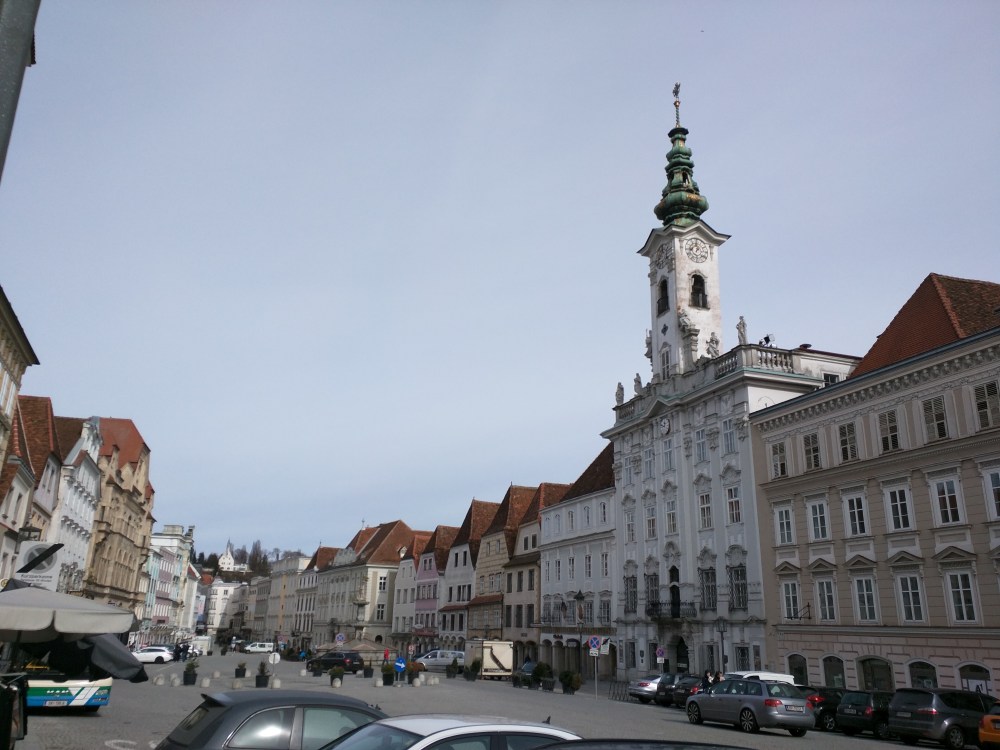
It’s 3-4 blocks long, and wide in the middle and narrow on both ends. It’s right on the edge of 1 of the rivers in Steyr, the Enns river. The building with the tower on it is City Hall. The clock tower was built to show how much wealth the city had*.
Steyr is a medival town. There is a castle here in the city. The courtyard is accessible and you can go inside.
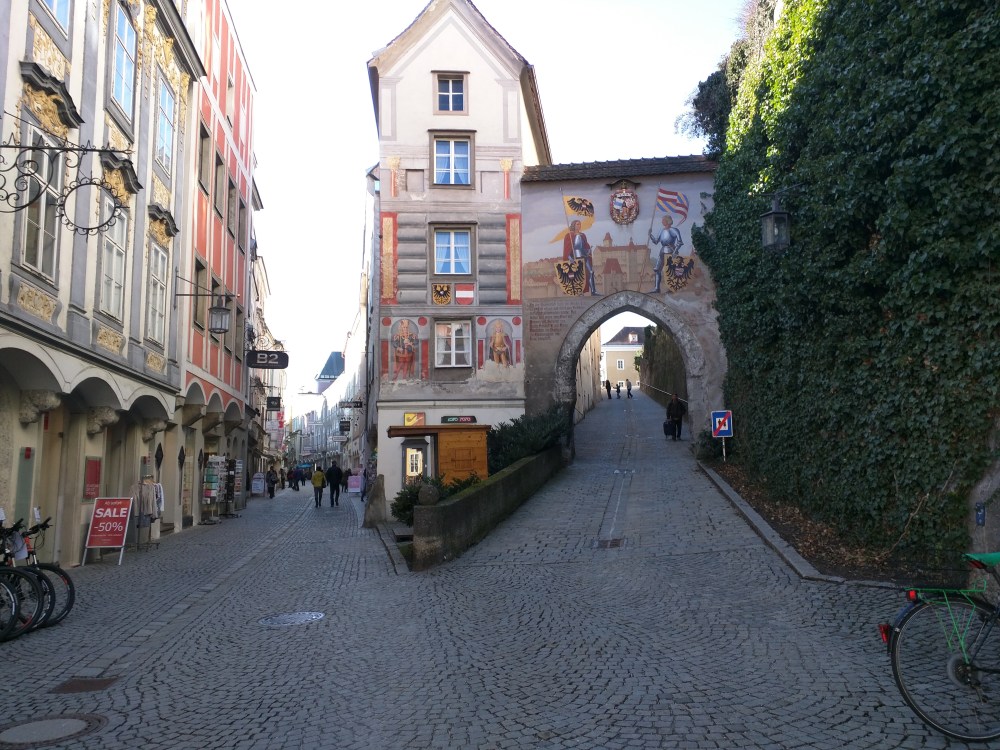
You walk up the path on the right of this picture. On the fresco above the arch is a picture of 2 knights. These 2 knights came to the convergence of the rivers and wanted to build up the city and castle. However, they had an argument whether to put the castle on this hill on the Enns, or on the other side of the river Steyr on the hill there. Whichever one wanted it on the Enns side won, obviously.
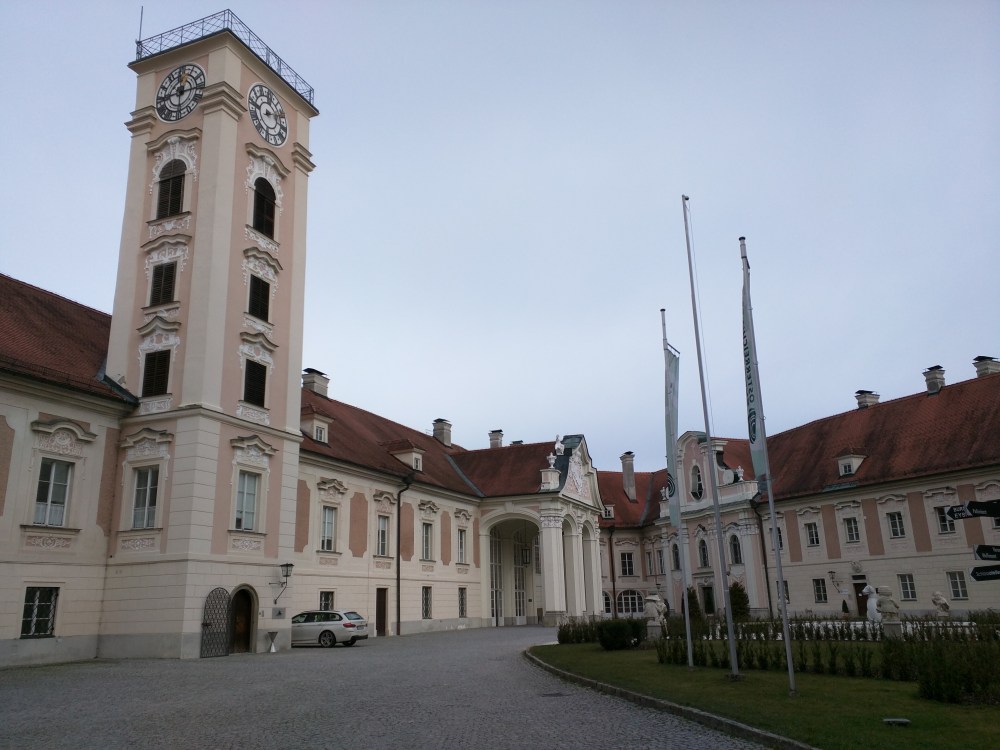
This is one angle of the courtyard. The castle is called Castle Lamberg, after the family Lamberg that lived there up until WW2, when the Nazi’s forced them out. The family took everything with them but the contents of the famous library inside, and so the castle is actually pretty empty. You can go on a tour of the inside and of the library, but that will have to be another day.
The courtyard is acctually in the shape of a triangle, as show below. The main point of the triangle points to where the Enns and Steyr rivers converge.
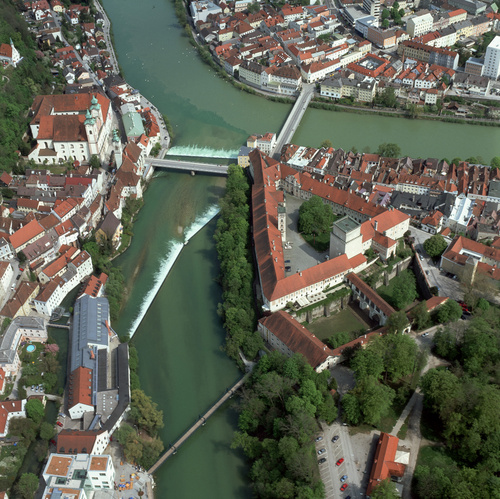
(not my picture)
In this picture you can kind of see there’s an open courtyard out behind the castle. In the summer, the hold outdoor theatre there, and they have “capricorns” who live there (big horned sheep, I think). There’s a tunnel that you can see in the middle of the back, and that leads to a big park open to public, where lots of people go running or play sports.
-This is also the park from my post yesterday where we built our contraptions-
I think you might be able to see our flat building in the picture, but I’m not sure. And the campus is also featured in this picture on the left side – it’s the cluster of buildings right along the river that end by the bridge that crosses the river along the bottom.
Steyr is also very famous and important for manufacturing. In medival times it was known for making the best knives and swords (pronounced swoo-urds by our tour guide) that were then taken and trades/sold in Italy and other countries. They would import Iron from a city along the Enns, and so ferryman would bring large shipments of iron on rafts down the river to be bought/sold in Steyr. Our tour guide told us a story that the raft-men were not allowed to know how to swim, or to learn how. Because the iron was expensive and valuable, they didn’t want the ferrymen to jump ship if they ran into trouble along the river. So if they couldn’t swim, they would be forced to stay and protect the cargo. That’s a pretty smart plan.
Steyr was also famous for weapons in WWI and WW2. They made rifles, guns, and later machine guns. Actually 1 of the buildings of our campus was a steel factory during the wars. Because of the importance of the city, it was bombed 5 different times by the Allies during WW2. There was a concentration camp about 30 minutes outside of the city, but as the demand for weapons increased, a secondary camp was set up in Steyr, and the people were forced to help build weapons and dig out an air-raid shelter underneath the hill the castle sits on. There isn’t a record of the deaths in the Steyr camp mainly due to if the inmates were sick or injured, they were sent to the other camp to die, and replaced with healthier people able to work. The air-raid shelter is now a museum that’s open for a couple hours on saturdays. I may go next week to take a tour.
Steyr is also known for the massive floods it has, due to the fact it has 2 rivers flowing through it. There was a huge flood back in 2002, resulting in millions of Euros in damages. The water rose about 20 feet (I think) from its place in the Enns, and flooded the Stadtplatz, which is one the second level of the city.
Steyr is very easy to navigate, as it is built on 3 levels. The 1st is level with the rivers, the 2nd is level with the bridges that cross the rivers/Stadtplatz, and the 3rd is on the hill, level with Lamberg Castle. So any road, alley or staircase will connect you with the various levels, and if you know what level you’re on, you can always find your way back to the rivers, the university campus, the castle or Stadtplatz. It’s pretty simple.
Some other interesting facts:
- Steyr is the 3rd biggest city in Upper Austria with around 40,000 people. The biggest is Linz, with Weis in second.
- it has an extremely high unemployment rate due to so many factories closing down after the war.
- The city is over 1000 years old, dating back to the 11th century. It celebrated being 1000 in the 80s, so it’s pretty old.
- BMW has a large manufacturing location in Steyr, where they make the engines of the cars.
- Fraz Schubert, a famous composer, composed his notable Trout Quintet while staying in Steyr. Here’s a link to the Trout Quintet, but its about 40 minutes long because it has several movements in it, so maybe don’t invest the time. Listen to it when you’re cooking dinner or something.
There are a bunch of other sites in Steyr that I think I will try to hit during my down time. Plus, walking is free. So that’s always good.
Thanks for coming on this adventure of sorts with me. We have to get up early tomorrow to catch the OBB train at 9 into Linz. It’s an all-day tour, so it’ll be a pretty busy day. Here’s the description (for my dad to get excited about it):
“ESN organises a trip for you, which includes some sight-seeing, a city tour with the famous little yellow train “Bummelzug” and a stop for dinner at a traditional austrian restaurant.
We meet at 10:00 at Linz train station and spend some time walking through the streets of the city. Places like Linz castle and Mary’s Cathedral are on our schedule. After an informative tour with the “Bummelzug”, our next halt will be Pöstlingberg, the local mountain of Linz, with its imposing church. Before we start our way back to Steyr, we planned a nice dinner at “Monte Verde”, an italian restaurant in Urfahr.
It would be a pleasute for us to spend this day with you and show you around the beautiful nooks of Linz.”
DAD WE’RE RIDING A TRAIN. JUST FOR YOU!
Anyways, hope you’re having a good day. For future reference, I’m 8 hours AHEAD of you, not behind you. So if it’s 6pm for you, its 2am for me. So don’t get offended if I don’t message you back until you’re asleep. Your midnight is my 8am, so I’m just getting your message now. Well actually, your message probably woke me up, and I was too annoyed to reply. #sorrynotsorry
BYE
emma.k
 Wandering Miss Emma.K
I loved your historical account of Steyr.That should qualify for some class assignment.
If you are thinking of bringing souvenirs home from Steyr for the Family I’ll take one of those BMW’s you mentioned.
I expect lots of pictures of the Linz Little Yellow Train. I love the name Bummelzug, we may have to change our train name from Dajbahn to Bummelzug.
LikeLike