Never Forget.
It was a struggle to get myself out of bed on Sunday morning. I really didn’t want to see anyone or talk to anyone.
However, I knew I had a commitment and I would regret not going. So I dragged myself down the hill to FH where I got on a bus with other students and travelled to Mauthausen.
Mauthausen is the biggest concentration camp in all of Austria, with several sub-camps, one located in Steyr.
The camp is located ontop of a “mountain” (big hill) and you can see all around for miles. It is also located right next to a large quarry.
Originally the camp was a forced labour camp for political prisoners – the quarry was a source of income for the camp owners, and with no costs for workers, the profits were even better. One of the most awful things to see at the camp is “The Stairs of Death” (Todesstiege). These are STEEEEEP stone stairs that lead up from the quarry to the camp. The prisoners literally had to build their way up. There are some awful pictures in the museum of prisoners carrying giant slabs of stone on their backs up these stairs.

There is a path from the main gates that lead to the stairs, which is also pretty steep. The cobblestones are also very uneven, and for me walking DOWN the hill in good shoes it was pretty uncomfortable – I can only imagine what it would be like going up with bad shoes and carrying 50 pounds of rock.


This trip was sponsored by ESN, so our tour was free! We only had to chip in 5euro for the rental of a bus to drive us around for the day.
We had an AMAZING tour guide named Martin. (#classicmartin)
One of the first things he showed us was a scale model of the camp. Most of the camp has been destroyed and removed, mainly due to budgets – they couldn’t afford to keep everything maintained. So many of the barracks and buildings built outside of the main wall are gone.
The first thing we saw was one of the gates.


Mauthausen really looks like an old castle – very medieval. This was the entrance used by German officers and officials – if you look through the gate you can see the garage doors where they could park their cars. Above those garages was the General’s quarters, the man that ran and was in charge of the camp.
Above the gate used to be a giant eagle and swastika, which was torn down almost immediately after the liberation of the camp. There’s a picture that Martin showed us of people tearing it down, but it is unclear who it is. It could have been ex-prisoners, fellow Austrians from the town, US soldiers; it means that there could be several different versions of the same story depending on who tore it down and why.
Outside of the gate was a giant water reservoir dug in the ground (now empty). Because most of the buildings in the camp were built from wood, this water was kept in case of fires. However, looking at it made me think of a swimming pool, which was in fact true – many guards would go swimming on hot days.
This was when Martin really made me think. He asked us “Why would they have a pool? Why is it built here in the front where people could see?”
Martin then laid down some wisdom. He reminded us that there is 2 sides to the concentration camp story. Most of the time we only think of the victims/prisoners and all the things that happened to them, and don’t talk about the Germans that were involved. But when you take out the oppressors, the event becomes a natural disaster – this big thing happened and lots of people were killed. The Holocaust was people hurting people, not just people being hurt. The officers and guards were people. And people want and need people things. The guards, just like anyone else, got hot in the summer and wanted to cool off. They wanted to go swimming. The camp was their life, and even inflicting pain becomes taxing on a human after a while, and a break is needed. So while we think of these people as monsters who just stood by and watched as awful things happened, they were people who liked eating sweets or swimming.
Also just past the pool was an open field that used to be a soccer field for the guards. They actually had their own team, and would travel and play against other town teams. In turn, teams would come and play at the camp’s field too.
This was also interesting because from pictures Martin showed us, you could see stands/seats where people could come and watch the games. Can you imagine people from the town coming up to sit outside the concentration camp to watch soccer while who knows what is happening 100 feet away?
It was obvious that people of Mauthausen (the village at the bottom of the mountain) knew what was happening at the top – wouldn’t they? Prisoners would get off trains at the town and be forced to walk through the village and up the mountain on foot – people obviously saw them. But living in a Police State means that you don’t talk about those sorts of things. You couldn’t trust anyone – not your neighbors, your friends; anyone may rat you out to save themselves. So people came to the games and didn’t talk about what happened behind the walls.
The soccer field was turned into a mass grave after liberation, where townspeople and US soldiers buried the bodies they found in the camp.Now the field is just open and clear.
A little ways down from the field was the place of the old sick camp. Prisoners that were sick or injured were sent here, where they would eventually die. Medicine was expensive, and treating patients was not a high priority – there would always be more coming soon. In addition, as the war went on, the camp commander made it a rule that if they were too sick or unable to work, their food allowance was cut in half, so they had even less chance of recovery.
The question posed to us by Martin was “If they had no chance of survival, why treat them at all? Why not just shoot them and move on?” And the answer came back to the fact that the guards were humans too. If I send a sick man to the sick camp and he dies there, its not my fault. If I shoot him, I’m to blame. If he is sick and dies, is it my fault? Maybe he was meant to die, but I did what I was supposed to do, and did what I could to “help” him. The sick camp gave some false sense of duty to the guards, and served the purpose of placing guilt.
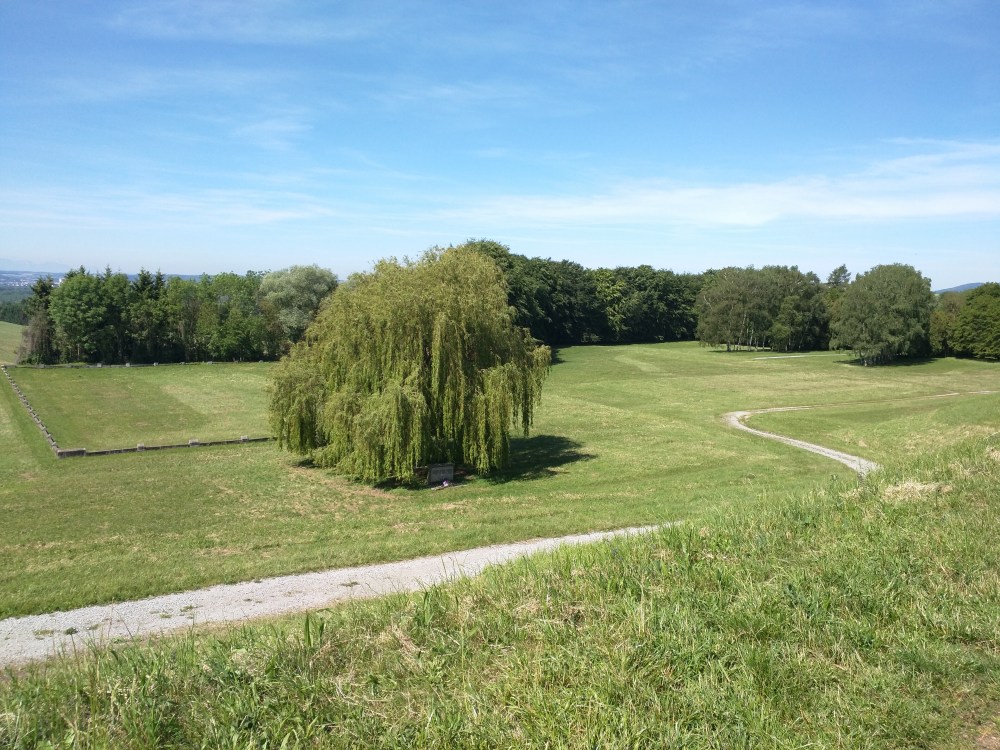
We followed the road along the wall to the back, where you could see the quarry and the main entrance gate. Between the quarry and the gate was Mauthausen’s “Memorial Park”. There were maybe 12-15 different national memorials set up by various countries and groups to honor the citizens that were killed in the camp throughout the war.


Martin talked to us a little bit about the SS, and how the camps were run. The SS were originally set up as special bodyguards – an elect group of soldiers to protect high ranking members of the government. Because of their “elite-ness”, they had the “look” – blond hair, blue eyes, etc. that Hitler wanted. They had to prove there was no Jewish family ties as far back at the 1700s in order to be a member as well. Eventually the SS grew more rapidly, and was put in charge of keeping the camps running – they weren’t the guards per say, they were more administrative roles or “enforcement” roles. They used to live in barracks outside the walls where the Memorial Park is now.
Inside the camp, only a few barracks still stand – the rest were taken down.
Immediately inside the gate was the “wailing wall”. New prisoners arriving to the camp were forced to stand along this wall anywhere from a few hours to a few days before they could be registered and allowed into the camp. This was used as a form of selection.
There is the story at Auschwitz (I believe) where the new prisoners would stand along the ramp to the camp and be inspected by a camp doctor. The doctor had a signal he would give if the prisoner was well enough to be of use, or if they were no good. The ones unable to work were taken away and killed.
At Mauthausen, the wailing wall served as a natural selection – the prisoners who collapsed from standing too long waiting outside were obviously too weak to be of use and were taken away. Along this wall more memorial plaques are placed for those that died in the camp.


Next was one of the cellars. It was right next to the wailing wall. This is where the prisoners would be taken to be shaved and showered. They would have their clothes taken from them and put in the laundry (also in the cellar), have their head shaved, shower in the mass shower room, and then be given the standard striped prisoner uniform.
Martin said that one of the biggest misconceptions of the shower room was that most visitors thought it was the gas chamber. The easiest way to tell it wasn’t was the fact that the controls were on the inside – if it was the gas chambers, they wouldn’t have the controls placed on the inside because then the officer in charge of them would also die.


There were stories that officers would torture prisoners with the temperatures of the showers: turning them burning hot and then switching it to freezing cold, back and forth until the prisoner collapsed.
The showers were also an example of how cruel the officers were. They were told to turn the water on, but they also controlled the temperature. Do you think they were nice and set them to a comfortable warm temperature for the prisoners? Very unlikely.
Next we went inside one of the prisoner blocks.
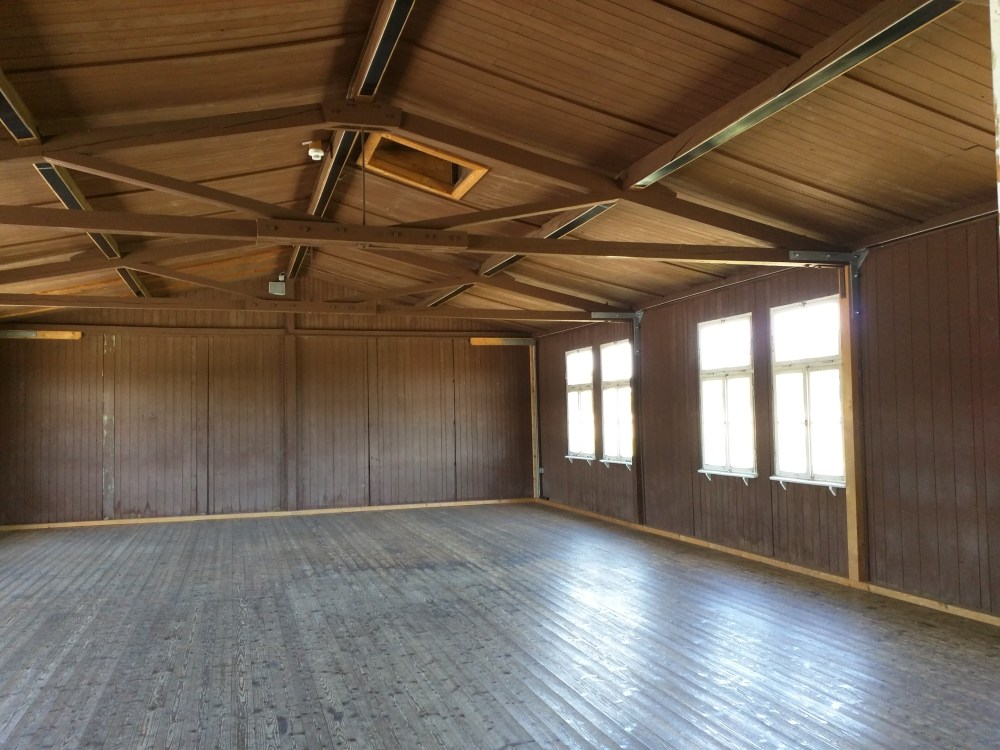
This is one sleeping room, and there were 4 rooms per block, with a small part in the middle for toilets, sinks, and a small place for food. Each block was originally designed for 350 people. However, near the end of the war, almost 1000+ prisoners would be in a block. At the time of liberation, almost 20.000 prisoners were kept in Mauthausen, while the camp was designed to hold about 1/3 of that number.
There was also a hierarchy within the camp. There were those that were favored among the prisoners that got special treatment in exchange for helping the soldiers. The guards would put these people in charge of a group of prisoners, and if something were to happen, the guards could easily blame that particular prisoner and kill him. And so among the prisoners there was a whole world of mistrust and abuse. Most of the time brutality was inflicted by other prisoners, not the guards.
Next we went into the main administration building where the “prison” was.
This cell block was mostly for special prisoners – politicians mostly. They were kept in solitude as opposed to put in with the rest of the people. The Germans didn’t want these people to stir up the other prisoners or tell them what was happening in the outside world, especially regarding the war. Plus, this building is the only one on the main square with the entrance at the back, so they could bring people in or out without anyone else seeing.
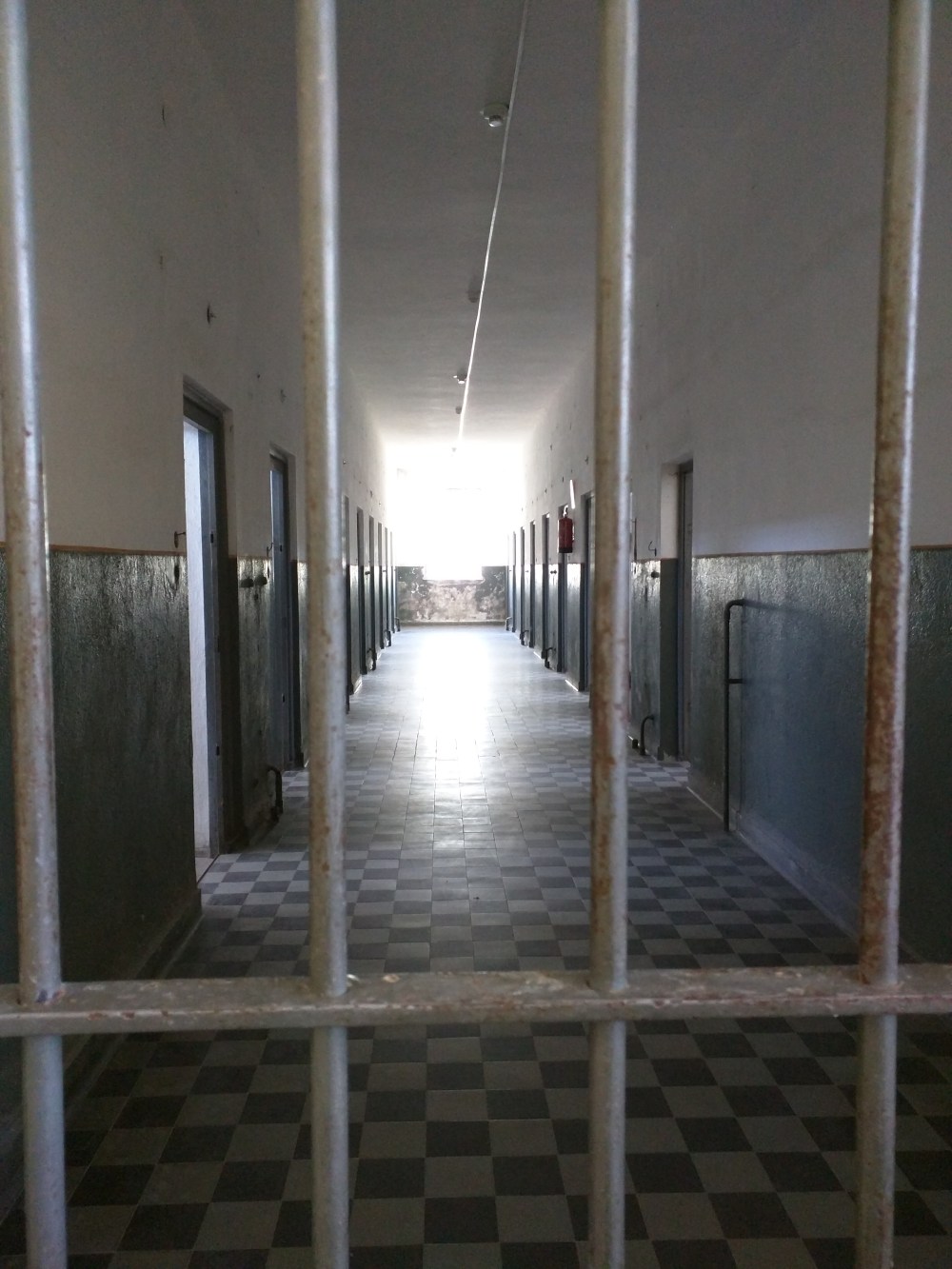
In the cellar of this building was where the first Crematorium was placed, along with an autopsy room and the “death chamber”- there was a second crematorium there at one point, and in the corner there used to be a device that allowed officers to shoot prisoners at the base of their neck to kill them.


One thing that I really appreciated was that before we went in, Martin talked to us briefly about what would be inside. He said that he would wait for us on the other side, and that we should walk through, read the signs, etc. He said that these rooms have different effects on people, and that we should be respectful of that, which is why he would let us go at our own pace, and then he would answer questions once we came through. I thought that was really respectful of him to allow tour groups to digest what they saw on their own.
From the cellar we went to another small graveyard set up inside the walls. This spot originally was used as a quarantine zone of sorts, and as the war went on it was the site of the women’s camp inside Mauthausen. Again, it was really small and hundreds of women were forced to live there. Now it is another memorial mass grave.

We then walked through the museum where there were more stories of inmates, some of the goings on, camp routines, pictures, etc. There was a memorial room where people places names and pictures of family members that died.
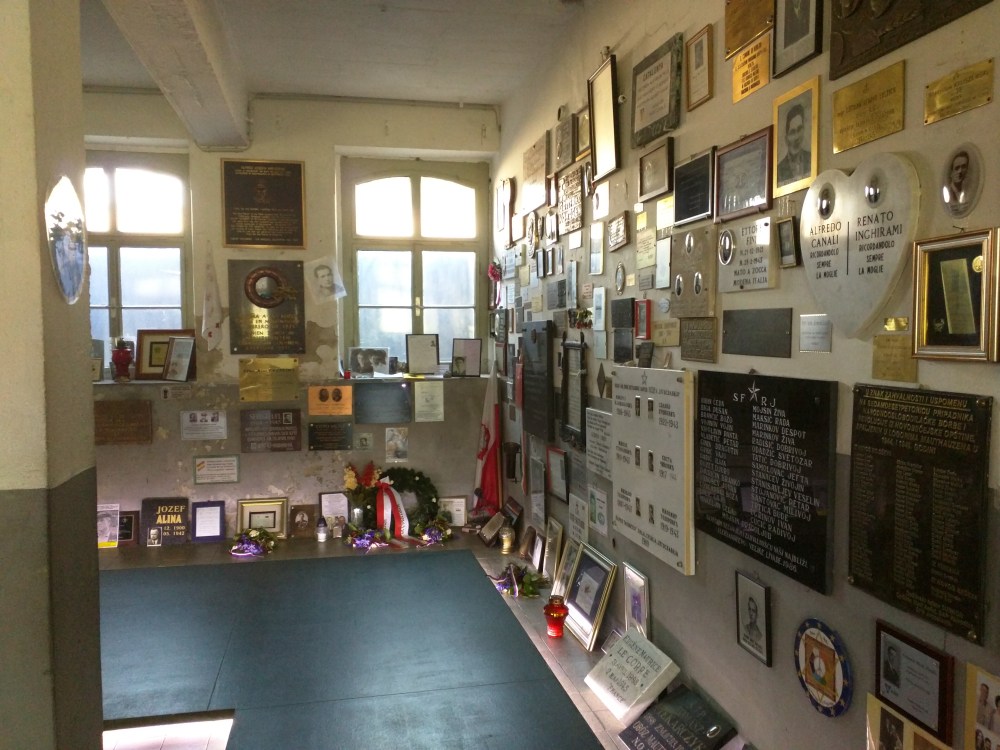
And, at the end was the Room of Names. This was very similar to the Pinkas Synagogue in Prague, but the names were printed on tables that lit up, There were also several giant books that held names. There was also a small bare patch near the back door to symbolize all those who’s names were not recorded or discovered that died.


It was also in this cellar that we saw the gas chamber. It was smaller then I had imagined, but that’s because gassing the prisoners wasn’t as common of a practice, especially not until near the end of the war. According to camp statistics (and don’t quote me because I don’t remember exactly) almost 1/3 of the total deaths of Mauthausen happened in the 6 months leading up to liberation. The Germans knew they wouldn’t win, but were determined to take as many people with them as they could. In the museum there were stories of how deaths were incorrectly documented to cover up the cruelty of the officers.What a shame.

Our tour lasted about 2,5 hours, and the weather was around 27-29 degrees! But it was amazing, and while the subject matter is hard to swallow, I thoroughly enjoyed the tour.
After Martin left, we wandered along the wall, and I stood on the balcony overlooking the courtyard – this is where the commander would stand to give orders and speeches to the officers and guards.


This is another part of history that I have never been exposed to. People who live in or around Mauthausen have to live with these things their whole lives. German and Austrian people have these things all around them forever. And I can only imagine how hard it would be to have that in your face all the time. North America is pretty distant when it comes to some of these things.
I’m really grateful that I have been able to visit some of these places and to learn more about a history that I am not exposed to. There are many lessons to be learned from places like this, and many things to be grateful for.
I’m glad I dragged myself out of bed for this trip. I really learned a lot, and felt a lot to be honest. I hope that I can help make the world a little bit better, and that if the time should come, stand up for what I believe to be right. I never want to have anyone live through anything like that again.
After Mauthausen we took the bus to a Mostbauer. Its a farm house restaurant kind of – all the food comes from the land and farm the family owns. There are certain rules like they can only be open on certain days, and other rules around serving alcohol, but its pretty cool. We are actually going to another one for my ACC class in a couple weeks so yay!
I ordered a typical austrian-style meat dish (can’t remember what it’s called). You get a few different kinds of sliced meat, some cheese (Topfen, which is a special kind and is REALLY good), some veggies, and lots of bread to eat it with. Our particular plate was slices of ham, bacon, and roast beef. It was SOO good.


We took the bus back to FH, and then many of us walked into Stadplatz to get some ice cream and then go to the river. Our usual spot was occupied by some other incomings who didn’t attend the trip, including my Irish friends! So we spent the last few hours of the afternoon enjoying the blazing sun and cool winds. My icecream melted really quickly haha.
I spent the evening in my room just relaxing/hiding in my bed. I had a wicked headache, probably from the heat/my lack of hydration throughout the day. Mostly I just wanted to be by myself after being surrounded by so many people all day.
I’m not sure what the future holds for me. Funds are getting tight, and with only a month or so left, my studies require more attention. I guess we’ll find out!
bye for now.
emma.k
 Wandering Miss Emma.K
One Comment Add yours