So titles are not my strong suit. I get it!
This week I have been to 2 different tours in Steyr.
The first was in “The Tunnel Of Rememberance”.
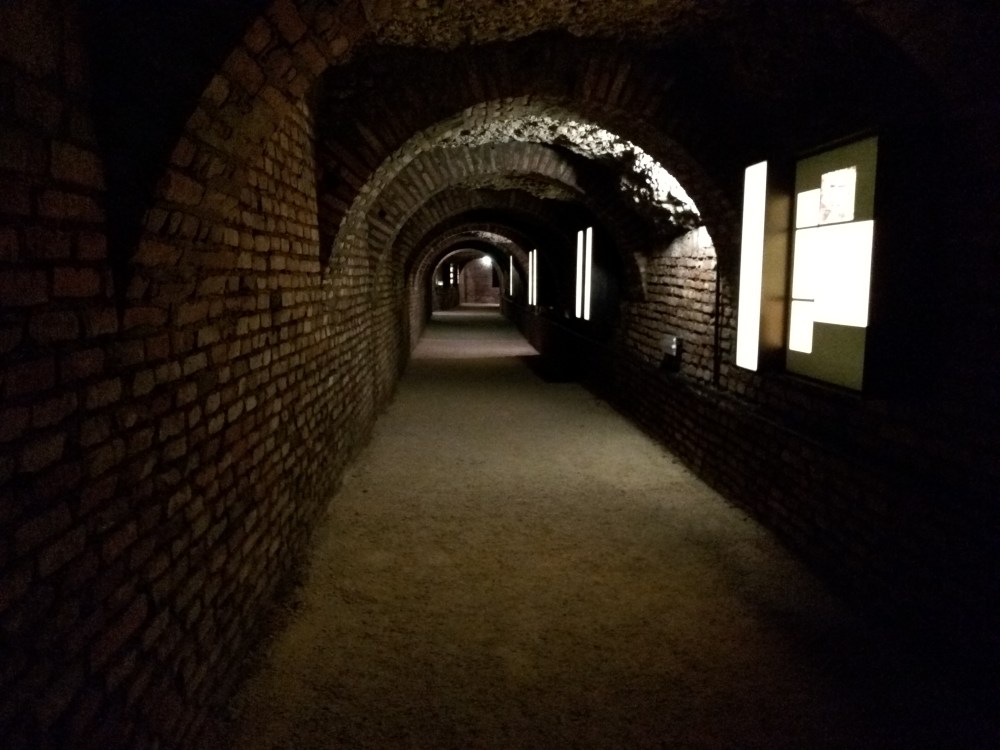
You may vaguely remember this being mentioned – it is a museum about WWII in Steyr, located inside the old Air Raid shelter tunnels under Schloß Lamberg.
Stey and WWII have a pretty intricate history. Some of this will be old news because I mentioned it in my post about our Steyr City Tour.
Steyr was a huge source for weapons for the Nazi forces during WWII. It was either the first or the second largest producer of tanks for the war. They made machine guns, rifles,tanks, etc. All this production ended up kinda saving the city. You know the saying in economics: “If you’re in need of money, go to war”.
Before the war, the city was almost over 50% unemployment. When the first weapons factories opened, there were 7.000 people working. By the end of the war, around 50.000 people worked in the factories.
Just outside Steyr by Linz is the biggest concentration camp in Austria – Mauthausen. There was also a concentration camp in Steyr in today’s Münichholz (Steyr). This camp was set up in the 40s because they needed a place for people who were forced to work in the factories. Most of the people in the camp were forced labor workers, with about 60% of them coming from Eastern Europe – Soviet Union, Czech, Poland – while the rest were from places like France, Italy, Belgium, etc.
There aren’t really any pictures of the camp and factories in Münichholz from when they existed. Pictures were not allowed, and citizens could get into huge trouble and/or killed for photos and sharing pictures of the camp. The camp did not have a wall or tall fence surounding it, it only had a barbed wire/electric fence. So anyone driving past the camp could see right into the camp and see all the things that were happening inside. The only pictures were taken by USA bomber pilots as they flew over the factories, with 1 or 2 other pictures taken by citizens that were hidden for years afterwards.
The prisoners inside the Steyr camp were transferred there from Mauthausen to work. The prisoners who were able to do the full workload were granted 3 potatoes a day. Those who were weak or ill had their food reduced, so they were not able to recover. There are no records of how many prisoners died in the camp – there were between 250-300 that were executed in the camp because of wrongdoings or whatnot, or were killed during working accidents, etc. but the prisoners that became too sick or weak to work were sent back to Mauthausen where they died, and were replaced with “fresh” prisoners to continue working.
The prisoners were in charge of working in the factories, but they also were required to dig the air raid tunnel. When it was completed and the siren went off for an air raid, none of the forced labor workers were allowed into the tunnel. Just like the Jewish people who had to wear gold stars on their clothes, people from Eastern Europe, Poland, etc. also had to wear badges on their clothes that labeled them. Anyone with these labels or in prisoners striped clothes were refused access to the shelter. There is a story of 60 Italian workers in a factory that had to stay in the factory during an air raid because they couldn’t go into the tunnel. The factory was hit with a bomb, was completely destroyed, and the 60 workers locked inside were killed. The workers were also responsible for clearing rumble and bombs (both exploded and not) after a raid. Often the bombs did not detonate when they landed, but would explode as the workers tried to move them, so many people died that way as well.
One thing new that I learned was that Steyr had one of the biggest crematoriums in Austria. Bodies from all over, mostly from Mauthausen were sent to Steyr to be burned. Several years ago, a grandchild of a prisoner who had died in Mauthausen came to Steyr in search of his grave. After some help from people in the city, they were digging around in the cemetary (close to my flat) where they found a secret grave under the sidewalk, filled with over(?) 1.000 Urns, nearly all of them labeled with the prisoner number or name. Unfortunately the boy’s grandfather wasn’t found, but many lost people were. Currently this grave is covered with a new sidewalk piece and is unmarked, which is a big problem because the urns should be taken out and given to family members, or at least be marked, but it can be expensive and right now no one is willing to pay for it. Which I think is too bad!
There are some stories of people within the town who would do small acts of resistance to help the prisoners. People would smuggle them food or clothes or medicine. Some citizens were taken away by the Gestapo and killed when they discovered they were helping the prisoners.
The concentration camp and factories were destroyed after WWII, and for a while Steyr was divided into 2 parts – the USA side and Soviet Union side, until the USA withdrew. Eventually Austria became a democracy and the Soviets also left. There was 1 barracks that was left standing, but remained empty. In more recent past, the city/historical society wanted to buy the barracks and set up a monument/museum inside of it. The man who owned the land heard about this and promptly demolished the whole building! How mean! He eventually sold the land, and now BMW owns pretty much all the land.
Speaking of BMW, that is where the second tour of the week took place! As part of my Austrian Culture and Civilization class my class went on a guided tour of the BMW plant in Steyr.


This plant is the biggest production of BMW engines in the world. 1,2 million engines are made every year in the Steyr plant, 70% of them are diesel engines.
We weren’t allowed to take any pictures inside the factories, so I don’t have any pictures from the tour.
I don’t know much about cars, and so the tour’s information was kind of lost on me. BUT it was cool to see anyways.
I know that my dad told me that if I was going to bring him back a souvenir, I should bring him a BMW, but unfortunately its only the engines that are assembled here, so the engine isn’t much use without the rest of the car….. sorry!
Its pretty cool to live in this city – its pretty small, but has been pretty important in history. It was bombed by the Allies 5 times because of its weapons manufacturing. Fun fact, Hitler actually attended the grammar school down the street from me for a year. So me and Hitler have walked the same streets – pretty interesting!
I really like learning about history, even though lots of times I forget it…..
Anyways, school has been okay. Everyone is gearing up for International Week.
QUESTION! Does anyone have some suggestions for Canadian foods/ foods that only we seem to eat or know, that I can make for the International Fair? I’ve got Pouutine, Maple Syrup candy, and maple bacon. I’m thinking of making scones – the dough fried in oil and covered in icing sugar. We also may try to do the traditional maple syrup candy things – where you pour the boiling syrup onto snow (ice) so it hardens. We aren’t allowed hot plates or things like that though, so it may be difficult. We’ll have to see.
Anyways, thanks for sticking with me!
emma.k
 Wandering Miss Emma.K
Glad to see you doing things in Steyr, remember the local historical train ride will start running pretty soon..
If you wanted to do something traditional you could do a stampede breakfast with maple syrup (or Stampede quizine like deep fired oreos, deep fired snickers, etc), nanaimo bars, tortierre, poutine, sucre al a creme, plug surprise, tim Horton donuts, butter tarts, …
Anyways have fun, I got to go get something to eat.,
LikeLike
Interesting that you and Hitler walked the same streets. So much history–and unfortunately quite a lot of sadness. Soak it all in.
LikeLike